



DETECTION OF STAPHYLOCOCCAL CASSETTE CHROMOSOME mec Type XI ENCODING HIGHLY DIVERGENT mecA, mecI, mecR1, blaZ and ccr GENES IN HUMAN CLINICAL CLONAL COMPLEX 130 METHICILLIN-RESISTANT STAPHYLOCOCCUS AUREUS


File Type:
Microsoft WordItem Type:
Journal ArticleDate:
2011Citation:
SHORE AC, DEASY EC, SLICKERS P, BRENNAN B, O'CONNELL B, MONECKE S, EHRICHT R AND COLEMAN DC, DETECTION OF STAPHYLOCOCCAL CASSETTE CHROMOSOME mec Type XI ENCODING HIGHLY DIVERGENT mecA, mecI, mecR1, blaZ and ccr GENES IN HUMAN CLINICAL CLONAL COMPLEX 130 METHICILLIN-RESISTANT STAPHYLOCOCCUS AUREUS, ANTIMICROBIAL AGENTS AND CHEMOTHERAPY, 55, 8, 2011, 3765 - 3773Download Item:

Abstract:
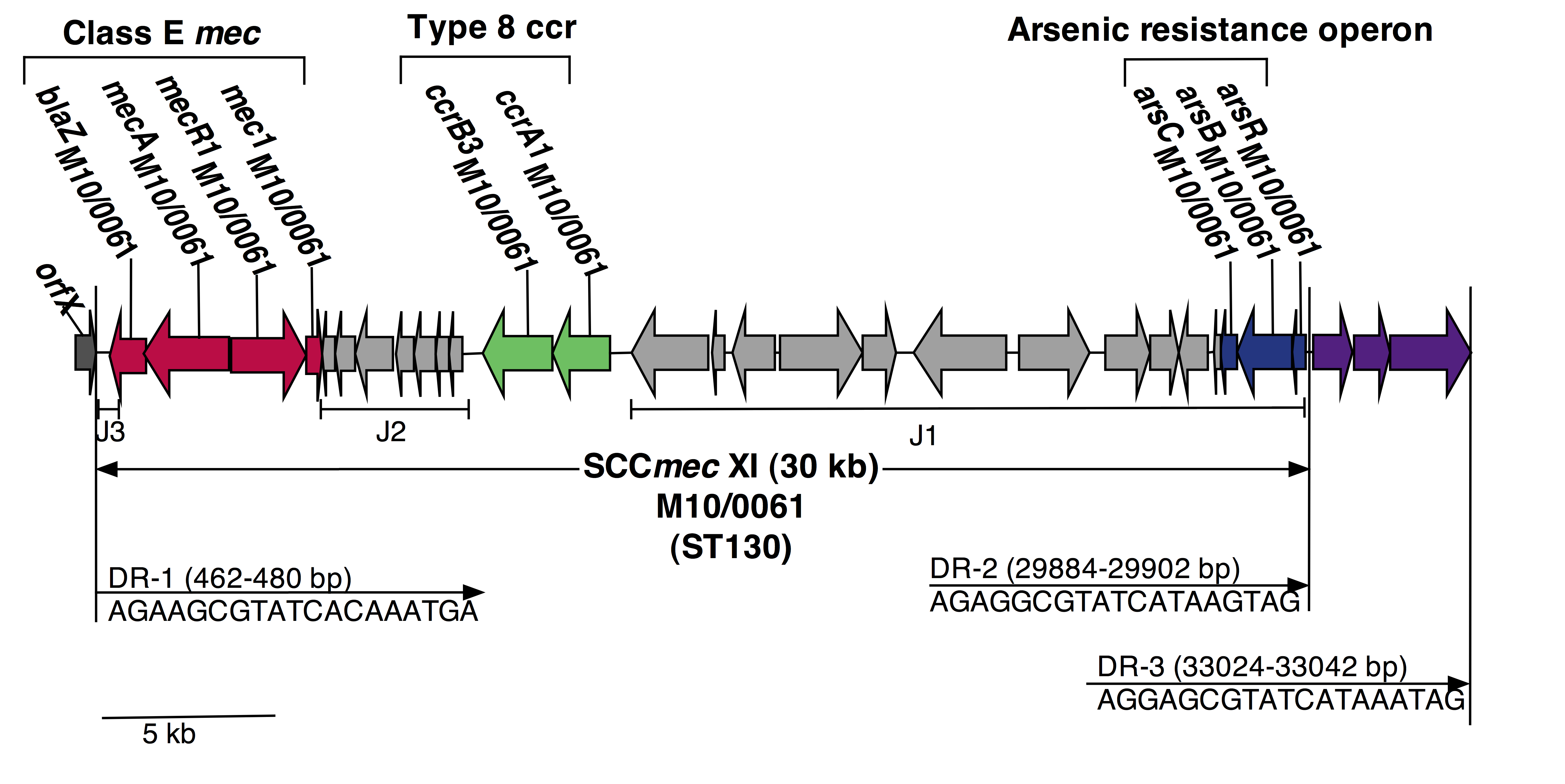
Methicillin resistance in staphylococci is mediated by penicillin binding protein 2a (PBP2a) encoded by mecA on mobile staphylococcal cassette chromosome mec (SCCmec) elements. In this study two clonal complex (CC) 130 methicillin-resistant Staphylococcus aureus (MRSA) isolates from patients in Irish hospitals were identified that were phenotypically PBP2a-positive but lacked mecA by conventional PCR and by DNA microarray screening. The isolates were identified as methicillin-susceptible S. aureus using the GeneXpert real-time PCR assay. Whole-genome sequencing of one isolate (M10/0061) revealed a 30 kb SCCmec element encoding a class E mec complex with highly divergent blaZ-mecA-mecRI-mecI, a type 8 cassette chromosome recombinase (ccr) complex consisting of ccrA1-ccrB3, an arsenic resistance operon and flanking direct repeats (DRs). The SCCmec element was almost identical to SCCmec XI identified by the Sanger Institute in the sequence type 425 bovine MRSA strain LGA251 listed on the website of the International Working Group on the Classification of Staphylococcal Cassette Chromosome Elements. The open reading frames (ORFs) identified within SCCmec XI of M10/0061 exhibited 21-93% amino acid identity to ORFs in GenBank. A third DR was identified ca. 3 kb downstream of SCCmec XI indicating the presence of a possible SCC remnant. SCCmec XI was also identified in the second CC130 MRSA isolate by PCR and sequencing. The CC130 MRSA isolates may be of animal origin as previously reported CC130 S. aureus were predominantly from bovine sources. The highly divergent nature of SCCmec XI relative to other SCCmec elements indicates that it may have originated in another taxon.
Author's Homepage:
http://people.tcd.ie/dcolemanhttp://people.tcd.ie/ashore
http://people.tcd.ie/deasyem
Description:
PUBLISHED2nd June; Epub ahead of print
Type of material:
Journal ArticleCollections
Series/Report no:
ANTIMICROBIAL AGENTS AND CHEMOTHERAPY55
8
Availability:
Full text availableKeywords:
mecA allotype, MRSA, CC130, SCCmec XISubject (TCD):
Immunology, Inflammation & InfectionDOI:
http://dx.doi.org/10.1128/AAC.00187-11Metadata
Show full item recordLicences: